
'%20fill-opacity='1'%20d='M%2061.308594%2037.511719%20C%2061.308594%2024.09375%2050.933594%2013.71875%2037.511719%2013.71875%20C%2024.207031%2013.71875%2013.71875%2024.09375%2013.71875%2037.511719%20C%2013.71875%2050.933594%2024.207031%2061.308594%2037.511719%2061.308594%20C%2050.933594%2061.308594%2061.308594%2050.933594%2061.308594%2037.511719%20M%202.777344%2037.511719%20C%202.777344%2018.339844%2018.34375%202.777344%2037.511719%202.777344%20C%2056.683594%202.777344%2072.246094%2018.339844%2072.246094%2037.511719%20C%2072.246094%2056.683594%2056.683594%2072.25%2037.511719%2072.25%20C%2018.34375%2072.25%202.777344%2056.683594%202.777344%2037.511719%20'%3e%3c/path%3e%3c/svg%3e)
AI Governance & Leadership · Executive Foundations
Would your team give the same answer you would?
Five short episodes, delivered as a private podcast, that give senior leaders clarity on AI governance — what’s really happening, what it actually requires, and what to address next.
Need the full route from foundations to implementation? Explore the four-course programme →
Prefer to hear the thinking first? Listen to the free 10-minute Executive Briefing →
Around 15 minutes per episode · listen anywhere · 14-day money-back guarantee
The gap worth checking
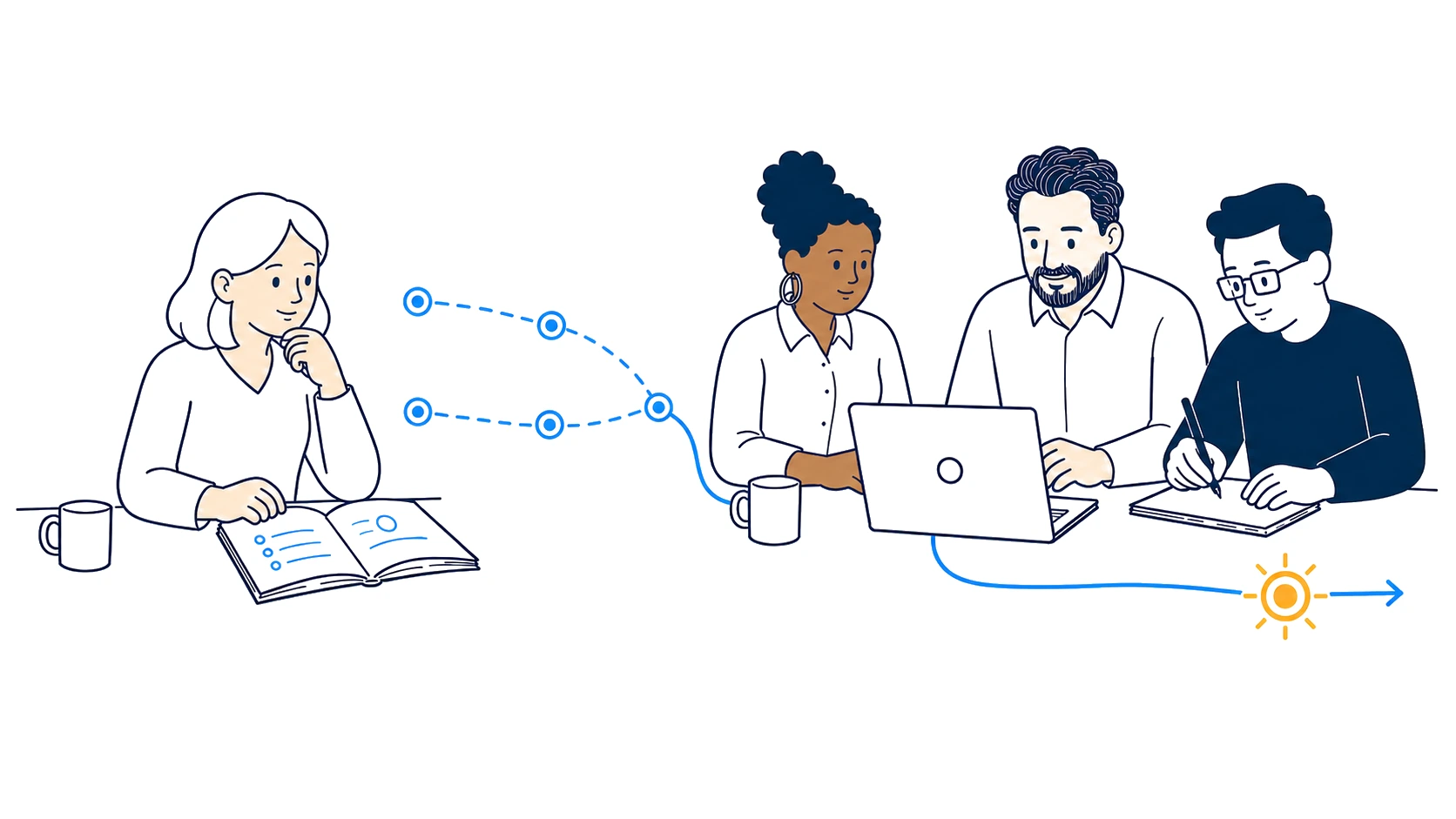
AI activity moves faster than organisational clarity.
Policies and approved tools can all exist while leadership still can’t see what’s happening in day-to-day work. The programme brings that down to three questions:
01 · Awareness
Do you know which AI tools are actually in use?
Your organisation provides Copilot. But someone in Finance uses their personal Claude account to analyse a spreadsheet because it gets them to the answer faster.
02 · Permission
Is it clear to everyone what good use looks like?
A manager wants to use ChatGPT to turn meeting notes into a client draft. The policy says “use AI responsibly” — but is this actually allowed?
03 · Ownership
Does a named person own the decisions?
A team wants to use AI to screen CVs. HR, IT and Legal all have a view — but nobody is quite sure who has the authority to make the final call.

The question isn’t whether your people use AI. It’s whether you’d both describe it the same way.
Why it matters
Why that gap matters
When the AI leadership can see and the AI people are actually using start to diverge, the consequence isn’t only risk. It becomes harder to know what to protect, what to build on — and where a decision needs to be made.
Risk sits outside view
Sensitive or client information can enter tools the organisation hasn’t vetted — beyond the safeguards leadership assumes are in place.
Useful practice stays isolated
Someone may have found a faster, better way to work. If it stays invisible, nobody can test it, improve it or decide whether it’s worth scaling.
Leadership reacts late
When permission and ownership are unclear, questions move between teams until something forces a decision. Governance becomes response rather than direction.

The format
Something you listen to, not something you sit through.
A private podcast in the app you already use. Five focused episodes, around 15 minutes each — on a commute, on a walk, between meetings.
Plus the application tools
Where the listening becomes something you can use.
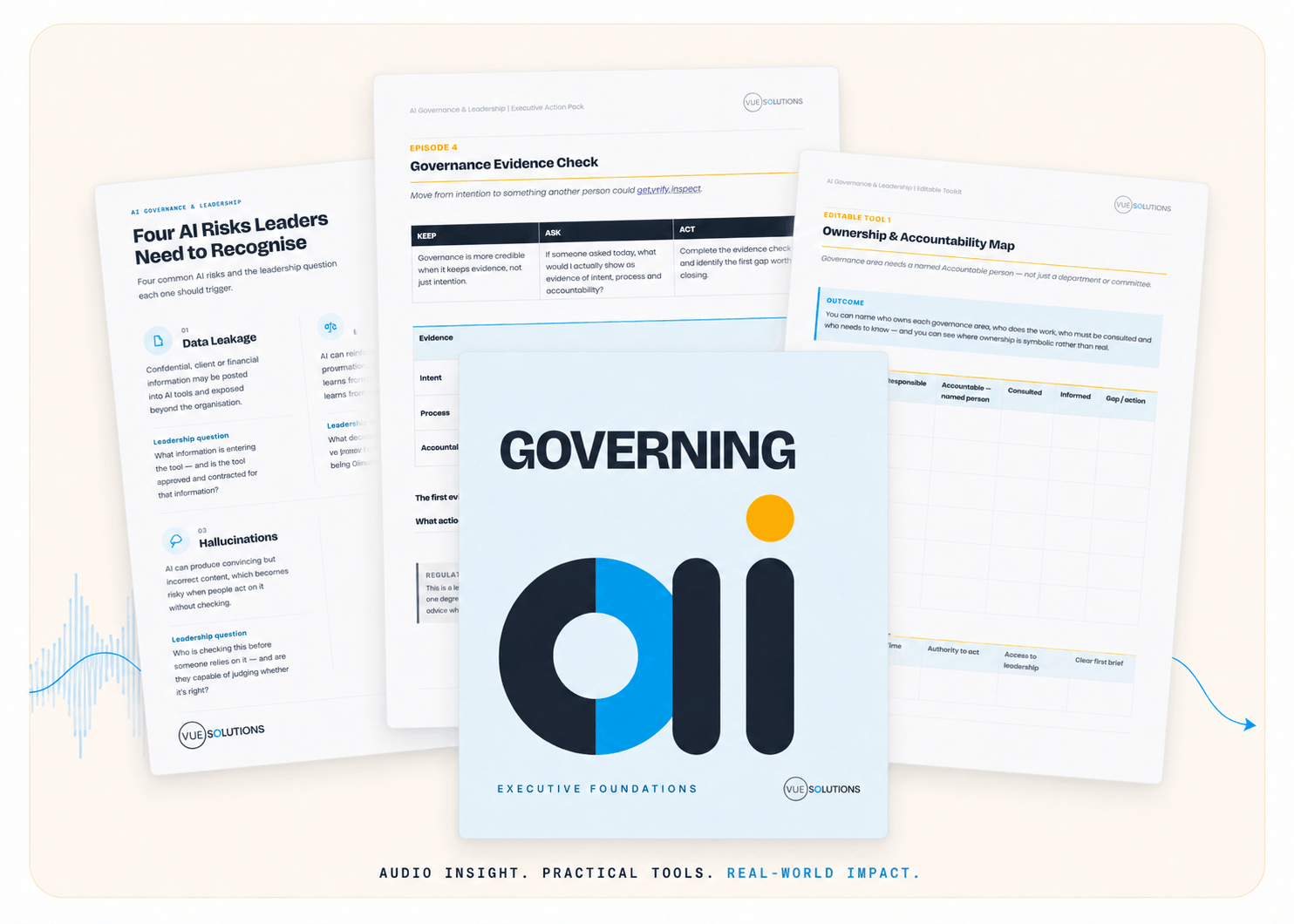
Executive Action Pack
Turns each episode into a decision, an evidence check, a named gap or a next conversation.
Editable toolkit
Worksheets and templates you can type into, adapt and reuse.
Quick-reference visuals
The core frameworks, ready to revisit after the audio has finished.
What’s inside
Five episodes. Five leadership questions.
Each episode is built around a question you should be able to answer — not a list of topics.
What you’ll walk away with
Five things you didn’t have before.
The programme is finished when there’s a named question, a named person and a next conversation — not when the audio ends.
Built from the work
Grounded in IT training, systems implementation and change management on real transformation programmes — not theory about how models work.
Built by Nadya Nathan
Nadya Nathan, Director of Vue Solutions, has led training and change across complex digital transformations in global pharma, fintech and SaaS — spanning systems implementation, business process change and new ways of working. A former Gold winner for IT Trainer of the Year.
Source discipline
Source-led content with a formal currency check on statistics and regulation before release. Educational guidance, not legal advice.
The wider programme
Start here. Continue if you need the full route.
Executive Foundations is designed to stand on its own. If the gaps you find extend into ownership, policy, risk, agentic AI or implementation, From Foundations to Action takes you further.
Executive Foundations
Available now
Governance in Practice
Releasing by end October 2026
Governing Agentic AI
Releasing by end November 2026
The 90-Day Governance Roadmap
Releasing by end January 2027
From Foundations to Action · four-course practical programme · £795 one time
Explore From Foundations to ActionFit
Made for the leader the question has landed on.
AI governance may not be in your job title. The questions may still be landing on your desk.
We’d rather be clear about the fit than persuade the wrong person.
 This is for you if…
 It isn’t if…
How it works
Four steps. No webinars.
1
Purchase once
One payment, with immediate access to the programme and resources.
2
Get your podcast
Your private podcast is sent to the email you use for course access, ready to add to your usual podcast app.
3
Listen where it fits
Five focused episodes — listen when your week allows.
4
Apply it
Capture the gap, evidence or conversation that matters in your organisation.
No new learning routine to master. No webinars to attend. No long blocks at a desk.
Executive Foundations
No subscription. No recurring charge. Lifetime access.
14-day money-back guarantee
No forms, no justification.
If it isn’t useful, tell us within 14 days of purchase for a full refund.
Buying through work? VAT receipt available after purchase.
Considering access for several leaders? Talk to us about team access →
Complete in its own right
Executive Foundations is designed to stand alone. If you later continue into From Foundations to Action, your £297 purchase is credited in full. At the current £795 programme price, you pay £498 to upgrade.
Want the complete route?
From Foundations to Action includes Executive Foundations plus Governance in Practice, Governing Agentic AI and The 90-Day Governance Roadmap.
£795 one time · £1,188 if all four courses are bought separately · save £393
Explore the full programmeListen before you decide · free · 10 minutes
Is your AI governance visible, usable and owned?
A 10-minute leadership briefing built around the Three Questions, with the quick-reference graphic. We’d rather you experience the thinking than take our word for it.
Listen here now. No email required.
Executive Briefing
Free · 10 minutes
01 · Listen
Three Questions for AI Governance
Audio arriving shortly — 10:12Awareness · Permission · Ownership
Transcript
You can have an AI policy. You can have approved tools. You can have people discussing AI at leadership meetings. And still be unable to answer three fairly basic questions about what is actually happening in your organisation.
What would that tell you? Not necessarily that nothing has been done. It might tell you something more useful: that governance exists somewhere in the organisation — but is not yet visible enough, usable enough, or clearly enough owned to guide what people actually do.
That is what this short briefing is designed to help you test. By the end, I want you to use three questions to test where your organisation stands, and identify where you most need greater clarity.
And there is one rule. Don’t look anything up. Don’t ask somebody else. Answer from what is currently visible to you as a leader.
Start with what we mean by AI governance. At its core, AI governance is the set of rules, processes, safeguards and ways of working that help an organisation use AI responsibly, safely, fairly and legally.
Underneath that are three things. Rules and Policies. Safeguards. Accountability.
Rules and policies create the boundaries: what people can do, what they can’t, and where they need approval. Safeguards create the checks where the stakes require them. And Accountability keeps responsibility with people.
Who owns the decision? Who can challenge it? Who remains answerable for the outcome?
Not: “The AI produced it.” Not simply: “That sits with IT.” Responsibility still needs a human name attached to it.
Rather than asking, “Do we have AI governance?” I want to give you a more practical diagnostic. Three questions: Awareness. Permission. Ownership.
If you have the accompanying Three Questions graphic, have it in front of you now. Just listen to each question and notice how easy — or difficult — it is to answer.
The first is the Awareness Question. Could you answer right now, with confidence, what AI your people are officially using — and what may be happening outside leadership visibility?
The official picture is usually easier. Which tools have been approved? Which teams are formally using AI? The harder question is whether that picture matches the working day.
Someone wants a faster first draft. Someone needs help analysing information. Someone experiments with a tool because it solves the problem in front of them. That does not automatically mean bad intent. But it can create a gap between the AI leadership knows about and the AI people are actually using.
And that matters in two directions. There may be risk you cannot see: sensitive information entering the wrong tool. But there may also be useful practice you cannot see: something that genuinely helps a team — but that nobody is learning from or considering whether to scale.
So Awareness is not simply about control. It is about understanding reality. If you cannot see the AI use, you cannot govern the risk properly. But you cannot learn from the value properly either.
If your immediate answer is, “I’d need to ask somebody,” notice that.
Now the second question. Permission.
Could you tell your team clearly what good AI use looks like in your organisation — what is encouraged, what is off limits, and why?
This is deliberately different from asking, “Do you have an AI policy?”
Imagine someone comes to you tomorrow and says, “I’d like to use AI for this piece of work. Is that okay?” Can you explain the boundary? Do they know what information should stay out? When a human needs to review the result? Who to ask if the situation is unclear?
Or does the answer become, “I think that’s probably okay.” “You’d better check.” “I’m not entirely sure what the policy says.”
That uncertainty matters. Some people will move ahead anyway. Others will avoid useful AI because they are worried about doing the wrong thing.
Permission means people understand the organisation’s position well enough to use it in a real decision. Could you explain what good AI use looks like here — without reaching for a document?
Then the third question. Ownership.
Is there a named person responsible for AI governance — with real time and real authority to act?
Not a department. Not: “IT handles AI.” Not: “Legal is looking at it.” Not: “We have a working group.” Who is the person?
Because naming somebody is not the same as creating ownership. Do they have time? Do they have enough authority to act? Can they reach leadership when something needs deciding? Without those things, ownership can become symbolic.
If somebody asks you tomorrow, “Who owns AI governance here?” could you name the person? Would they give the same answer? And does that answer mean something in practice?
Now bring the three questions together. Awareness. Permission. Ownership.
And answer them personally. Do not answer on behalf of the organisation. Do not answer what you hope is true. Answer what is visible to you.
First: Awareness. Could you answer right now — with confidence — what AI your people are officially using and what may be happening outside leadership visibility? Give yourself a moment.
Now: Permission. Could you tell your team clearly what good AI use looks like here — what is encouraged, what is off limits, and why? Could you explain it without checking anything?
And finally: Ownership. Is there a named person responsible for AI governance — with real time and authority to act? Who is it?
Now look at your three answers. Which one was hardest? Not which sounds most important in theory. Which one could you not answer with confidence?
Awareness? Permission? Or Ownership?
That is the gap I want you to keep. Because something previously vague has now become more specific.
“We need better AI governance” is difficult to act on. “I don’t know what AI people are actually using” is useful. “Our people cannot easily tell what is permitted” is useful. “We do not have a clearly supported owner” is useful.
Now you know where to look.
And your next move does not need to be enormous. If Awareness was hardest, start with a conversation about what AI is actually being used, where it is helping, and what need people are trying to meet.
If Permission was hardest, test whether somebody doing real work can understand the boundaries without having to interpret a policy for themselves.
And if Ownership was hardest, put a name against the responsibility — then test whether that person has the time and authority to make the ownership real.
The purpose is not to build perfect governance overnight. It is to turn an abstract concern into something visible enough to act on.
So reconstruct the logic. AI governance is broader than a policy. It combines clear boundaries, appropriate safeguards and human accountability.
Awareness asks whether you understand the reality of AI use. Permission asks whether people know what good AI use looks like here. Ownership asks whether somebody is genuinely responsible, with the time and authority to act.
Three questions. Simple enough to remember. But difficult to answer convincingly if governance exists mainly as intention.
Before we finish, three questions to leave with you.
Of Awareness, Permission and Ownership, which could you not answer confidently without checking with somebody else?
What is the first piece of clarity you need in order to improve that answer — something you need to ask, see or have named?
And if your team asked you the same three questions thirty days from now, what would you want to be able to answer differently?
If this briefing has revealed a gap, that is useful. You do not need a perfect governance system overnight.
You need enough visibility to understand what is happening. Enough clarity for people to know how to act. And enough ownership for somebody to move the organisation forward.
That is where practical AI governance begins.
The Executive Foundations programme goes further into the questions underneath this diagnostic: the gap between AI activity and value, what governance actually requires, the risks leaders cannot simply delegate, the regulatory environment, and the leadership mindsets that make governance operate in practice rather than remain on paper.
But for now, keep the three questions in front of you. Awareness. Permission. Ownership.
And keep the one you found hardest. Because that is probably where your next leadership conversation needs to begin.
About the narration: The voice you’re hearing is a professional AI-synthesised voice. The briefing is researched, written, structured and quality-controlled by Vue Solutions. AI is used for narration; the teaching, judgement and editorial decisions remain with Vue Solutions.
Questions before you buy
The things senior buyers actually ask.
If your question isn’t here, ask us directly — we’d rather answer it before you buy.
How is the audio produced?
Vue Solutions researches, structures, writes and quality-controls the programme. Narration uses a professional AI-synthesised voice. AI supports production; it doesn't replace source research or editorial judgement.
Will this help with the EU AI Act?
Yes, at leadership-orientation level. Episode 4 covers its risk-based logic, the UK picture and the evidence questions leaders should ask. Not a compliance audit or legal advice.
Is this enough to implement AI governance?
It gives you the leadership landscape and a clear diagnostic of where to look next, not a full implementation manual. From Foundations to Action goes further into ownership, policy, risk, agentic AI, culture and a 90-day action route.
How long do I have access?
Lifetime access to the audio and accompanying resources.
What is From Foundations to Action?
It is the full four-course AI Governance & Leadership programme: Executive Foundations, Governance in Practice, Governing Agentic AI and The 90-Day Governance Roadmap. Executive Foundations is available now, with the remaining courses releasing by the end of October 2026, November 2026 and January 2027 respectively.
What if I buy Executive Foundations and later want the full programme?
Your £297 Executive Foundations purchase is credited in full against the current £795 programme price, so you pay £498 to upgrade. Existing learners are given the upgrade route when they are ready to continue.
Do I need a technical background?
No. It assumes organisational experience, not technical fluency.
Can I buy access for a leadership team?
Yes. If you are considering access for several leaders in your organisation, contact us about team access. We can talk through what you need before you buy.
Will I receive a VAT receipt?
Yes. Your order receipt includes applicable VAT details and remains available in your account after purchase.
What if it genuinely isn't for me?
Tell us within 14 days of purchase and we'll refund the purchase in full. No forms, no justification.