
'%20fill-opacity='1'%20d='M%2061.308594%2037.511719%20C%2061.308594%2024.09375%2050.933594%2013.71875%2037.511719%2013.71875%20C%2024.207031%2013.71875%2013.71875%2024.09375%2013.71875%2037.511719%20C%2013.71875%2050.933594%2024.207031%2061.308594%2037.511719%2061.308594%20C%2050.933594%2061.308594%2061.308594%2050.933594%2061.308594%2037.511719%20M%202.777344%2037.511719%20C%202.777344%2018.339844%2018.34375%202.777344%2037.511719%202.777344%20C%2056.683594%202.777344%2072.246094%2018.339844%2072.246094%2037.511719%20C%2072.246094%2056.683594%2056.683594%2072.25%2037.511719%2072.25%20C%2018.34375%2072.25%202.777344%2056.683594%202.777344%2037.511719%20'%3e%3c/path%3e%3c/svg%3e)
AI Governance & Leadership · Four-course practical programme
From seeing the gap to doing something about it.
AI governance may not be in your job title. The questions may still be landing on your desk. From Foundations to Action gives you a practical route from understanding what is really happening to putting workable governance in place and turning it into action.
Built for senior leaders who need to make sensible decisions about AI without becoming the technical, legal or governance specialist.
£795 one time · Four courses · No subscription · 14-day money-back guarantee
Prefer to start smaller? Buy Executive Foundations for £297
The four-course route
Start immediately with Executive Foundations. Courses 02–04 are included as they release through January 2027.
One programme · 01 → 04
Why this exists
AI governance rarely arrives as one neat problem.
What starts as a question about an AI tool quickly becomes a question about use, ownership, permission, risk and what leadership does next.
Use
People are already finding ways to use AI. Some are approved. Some are not. Either way, decisions are already being made.
Ownership
HR, IT, Legal and business teams may all be involved. That does not mean anyone clearly owns the outcome.
Action
AI is moving from generating content to taking actions. The governance question gets sharper when a system can access, send, update or act on your behalf.
Follow-through
Even when the gaps are visible, somebody still has to decide what happens first, who owns it and when leadership looks again.
Seeing the problem is the start. The programme is designed to help you move through it.
The pathway
One leadership problem.
Four moves.
This is not four disconnected courses. It is one route through the problem, with each course answering the question the previous one leaves behind.
See clearly
Executive Foundations
Find out where AI is really being used, what good use looks like and where ownership is unclear.
Make it workable
Governance in Practice
Turn awareness into named accountability, a proportionate decision forum, usable policy and risk-based oversight.
Govern what can act
Governing Agentic AI
Extend governance from generated outputs to delegated actions, then address the human layer that makes controls work.
Turn it into action
The 90-Day Governance Roadmap
Translate the gaps into priorities, owners, dates, a 90-day plan and a governance rhythm that can continue.
Start where you are
Start where the problem actually is.
You do not need to buy more learning than you need. Executive Foundations is complete in its own right. The full programme is there when the problem is wider than one diagnostic step.
Start with clarity
Executive Foundations
Choose this if you first need to see the picture clearly. Find out where AI is being used, what good use looks like, where ownership is unclear and which leadership conversation needs to happen next.
Available now · £297
Take the full route
From Foundations to Action
Choose the full programme if you already know the issue goes beyond visibility, or you want the complete route through ownership, policy, risk, agentic AI and implementation.
Four courses · £795 one time
Already own Executive Foundations? Upgrade to the full programme for £498. Your £297 purchase is credited in full.
Executive Foundations
See the picture clearly.
Could you say with confidence where AI is being used in your organisation, what good use looks like, and who actually owns it?
Five focused episodes help you work through the leadership questions that sit underneath responsible AI use. Not a list of rules. A way to see the organisation more clearly and know what needs attention next.
Five leadership questions
What you leave with
A clearer view of the live gap, the evidence you need next and the leadership conversation that needs to happen.
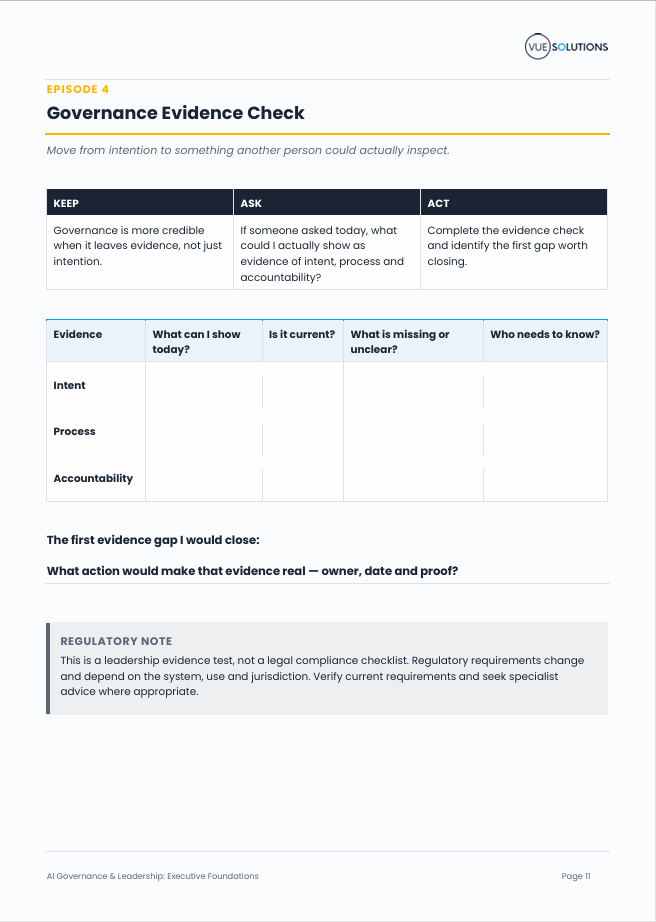
Action Pack
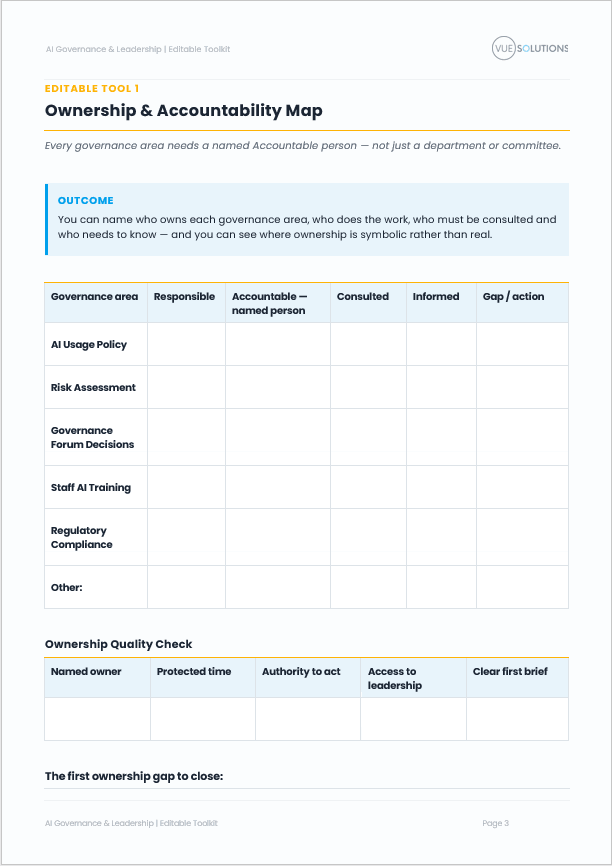
Editable tool
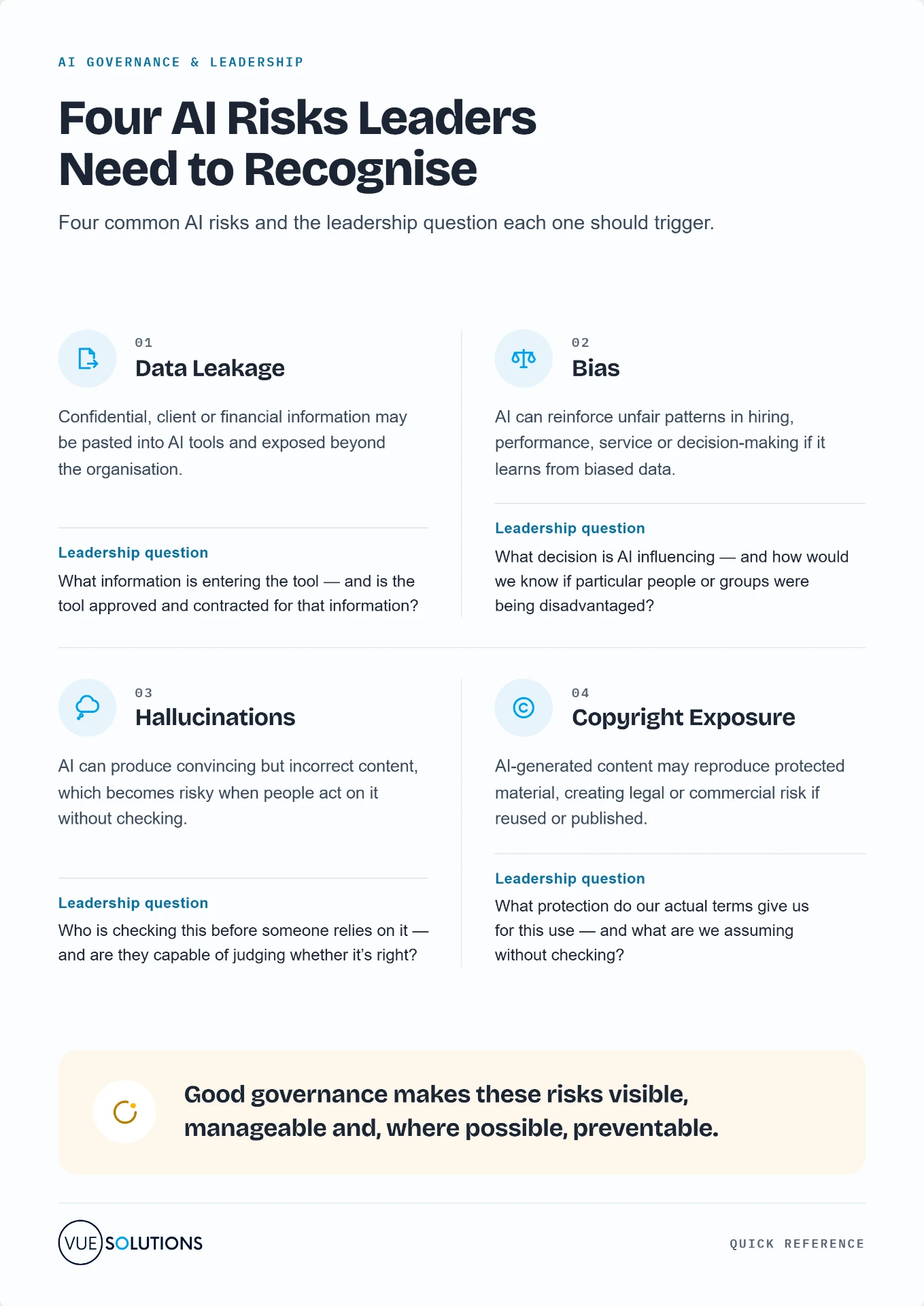
Quick guide
Included now: Private podcast · Executive Action Pack · Editable Toolkit · Quick Guides
Governance in Practice
Make governance usable.
Could you show how AI governance works day to day, not just on paper?
This is where awareness becomes a working structure. You move from “somebody should own this” to named accountability, a practical decision forum, policy people can actually use, and oversight that scales with risk.
Four governance questions
A ten-page policy nobody can explain is not governance.
What you leave with
Clearer ownership, a proportionate governance forum, usable policy and a practical way to focus oversight where risk is highest.
Governing Agentic AI
Govern what can act.
What changes when AI starts taking actions on your organisation’s behalf?
The stakes change when AI can do things, not just say things. This course helps you ask what an agent can access, what it can do, who approved it, where a human must review, and how it can be stopped. It also tackles the human layer: leadership behaviour, fear, adoption and co-creation.
Three questions to ask when AI starts acting
The technology is the easy part. The culture is the work.
What you leave with
A practical way to question delegated AI action, define pre-deployment controls and lead adoption without losing human accountability.
The 90-Day Governance Roadmap
Turn the gaps into action.
Knowing where the gaps are is not the same as closing them.
This is where diagnosis becomes a plan. You decide what changes first, who helps make it happen, what should move in the first week, what needs to be in place by Day 30, and how governance becomes something the organisation keeps doing.
Six moves from awareness to action
What you leave with
Priorities, owners, dates, a 90-day action route and a governance rhythm you can keep alive after the programme.
The course closes with a 30-Day Governance Review so the last destination is not another lesson. It is a date in your own governance journey.
Learning outcomes
By the end of From Foundations to Action, you will be able to:
Diagnose the organisation's real AI position and identify the gaps that matter.
Create clear ownership and proportionate cross-functional governance.
Make AI policy usable and apply proportionate risk-based oversight.
Navigate risk, regulation and evidence with sound leadership judgement.
Govern AI that can act, not just AI that can generate.
Lead the human and cultural conditions that make governance work in practice.
Turn governance gaps into a practical implementation route and recurring rhythm.
What changes
What should be different when this becomes real?
The goal is not to know more about AI governance. It is to be able to make better decisions, show how those decisions are owned and keep the work moving after the learning ends.
AI use is more visible
You have a more honest view of official use, unofficial use and where evidence is missing.
Ownership is named rather than assumed
Key governance areas have an accountable person, not just a department or a vague “shared responsibility”.
Policy helps people make real decisions
People can find it, understand it, know what is approved and know who to ask when the answer is not obvious.
Risk attention scales with the stakes
Higher-risk uses get more attention without turning every low-risk use into a bureaucracy exercise.
Agent permissions and human checkpoints are explicit
Access, actions, approval, review and the off switch are discussed before deployment.
Governance has owners, dates and a working rhythm
Owners, dates, reviews and leadership conversations make it a habit rather than a one-off project.
Learning should change what happens next.
From listening to working
Where the listening becomes something you can use.
The audio builds understanding. The working hub is where a useful thought becomes an evidence check, a decision, an owner, an artefact or a next conversation.
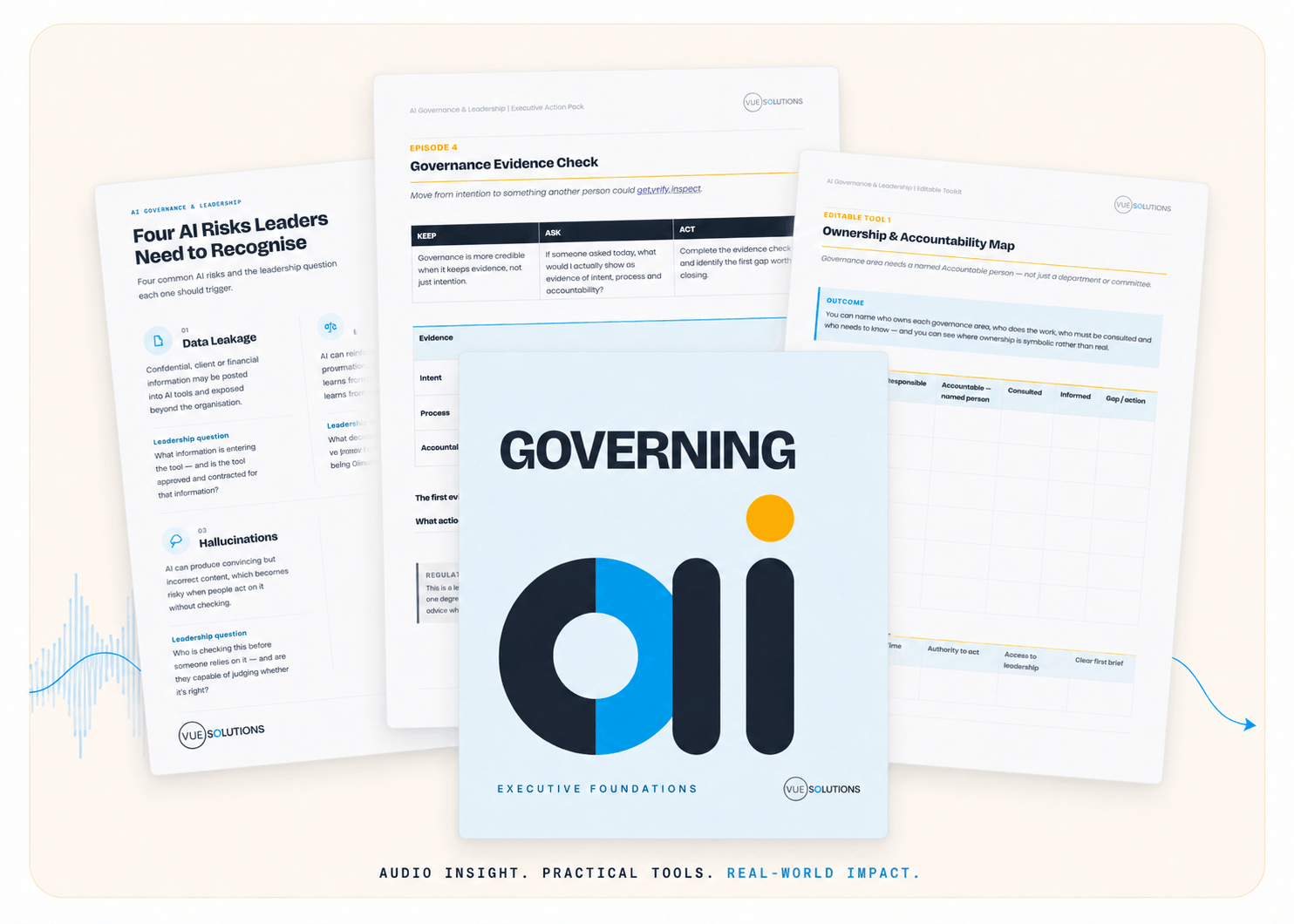
Diagnose and decide
Action Packs
Use focused prompts to diagnose a gap, test a decision and decide what needs attention next.
Take it into the work
Editable Tools
Adapt practical working artefacts and take them into leadership conversations, team meetings and governance work.
Reference in the moment
Quick Guides
Reconstruct the important frameworks without replaying a full episode when you need them in the moment.
Each course includes its own Action Pack, Editable Toolkit and Quick Guides. Executive Foundations includes the finished set now. The later-course tools are added with each course release.
Built around a senior week
Something you listen to. Something you use.
Build understanding while you move. Come back to the working hub when you have a few focused minutes and something needs to change.

Listen
While you move
Private podcast episodes, usually around 15 minutes, delivered to the podcast app you already use. On a commute, on a walk, between meetings.
Apply
Back at the desk
A focused Vue Solutions learning hub with Action Packs, editable tools and quick references. Use it when you need to capture the gap, check the evidence or move a conversation forward.
No new learning routine to master. No webinars to attend. No long blocks at a desk.
Hear it first
Listen before you decide.
The best way to judge an audio programme is to hear how it thinks.
Free · 10 minutes · No commitment
Is your AI governance visible, usable and owned?
01 · Listen
Three Questions for AI Governance
Audio arriving shortly — 10:12Awareness · Permission · Ownership
Transcript
You can have an AI policy. You can have approved tools. You can have people discussing AI at leadership meetings. And still be unable to answer three fairly basic questions about what is actually happening in your organisation.
What would that tell you? Not necessarily that nothing has been done. It might tell you something more useful: that governance exists somewhere in the organisation — but is not yet visible enough, usable enough, or clearly enough owned to guide what people actually do.
That is what this short briefing is designed to help you test. By the end, I want you to use three questions to test where your organisation stands, and identify where you most need greater clarity.
And there is one rule. Don’t look anything up. Don’t ask somebody else. Answer from what is currently visible to you as a leader.
Start with what we mean by AI governance. At its core, AI governance is the set of rules, processes, safeguards and ways of working that help an organisation use AI responsibly, safely, fairly and legally.
Underneath that are three things. Rules and Policies. Safeguards. Accountability.
Rules and policies create the boundaries: what people can do, what they can’t, and where they need approval. Safeguards create the checks where the stakes require them. And Accountability keeps responsibility with people.
Who owns the decision? Who can challenge it? Who remains answerable for the outcome?
Not: “The AI produced it.” Not simply: “That sits with IT.” Responsibility still needs a human name attached to it.
Rather than asking, “Do we have AI governance?” I want to give you a more practical diagnostic. Three questions: Awareness. Permission. Ownership.
If you have the accompanying Three Questions graphic, have it in front of you now. Just listen to each question and notice how easy — or difficult — it is to answer.
The first is the Awareness Question. Could you answer right now, with confidence, what AI your people are officially using — and what may be happening outside leadership visibility?
The official picture is usually easier. Which tools have been approved? Which teams are formally using AI? The harder question is whether that picture matches the working day.
Someone wants a faster first draft. Someone needs help analysing information. Someone experiments with a tool because it solves the problem in front of them. That does not automatically mean bad intent. But it can create a gap between the AI leadership knows about and the AI people are actually using.
And that matters in two directions. There may be risk you cannot see: sensitive information entering the wrong tool. But there may also be useful practice you cannot see: something that genuinely helps a team — but that nobody is learning from or considering whether to scale.
So Awareness is not simply about control. It is about understanding reality. If you cannot see the AI use, you cannot govern the risk properly. But you cannot learn from the value properly either.
If your immediate answer is, “I’d need to ask somebody,” notice that.
Now the second question. Permission.
Could you tell your team clearly what good AI use looks like in your organisation — what is encouraged, what is off limits, and why?
This is deliberately different from asking, “Do you have an AI policy?”
Imagine someone comes to you tomorrow and says, “I’d like to use AI for this piece of work. Is that okay?” Can you explain the boundary? Do they know what information should stay out? When a human needs to review the result? Who to ask if the situation is unclear?
Or does the answer become, “I think that’s probably okay.” “You’d better check.” “I’m not entirely sure what the policy says.”
That uncertainty matters. Some people will move ahead anyway. Others will avoid useful AI because they are worried about doing the wrong thing.
Permission means people understand the organisation’s position well enough to use it in a real decision. Could you explain what good AI use looks like here — without reaching for a document?
Then the third question. Ownership.
Is there a named person responsible for AI governance — with real time and real authority to act?
Not a department. Not: “IT handles AI.” Not: “Legal is looking at it.” Not: “We have a working group.” Who is the person?
Because naming somebody is not the same as creating ownership. Do they have time? Do they have enough authority to act? Can they reach leadership when something needs deciding? Without those things, ownership can become symbolic.
If somebody asks you tomorrow, “Who owns AI governance here?” could you name the person? Would they give the same answer? And does that answer mean something in practice?
Now bring the three questions together. Awareness. Permission. Ownership.
And answer them personally. Do not answer on behalf of the organisation. Do not answer what you hope is true. Answer what is visible to you.
First: Awareness. Could you answer right now — with confidence — what AI your people are officially using and what may be happening outside leadership visibility? Give yourself a moment.
Now: Permission. Could you tell your team clearly what good AI use looks like here — what is encouraged, what is off limits, and why? Could you explain it without checking anything?
And finally: Ownership. Is there a named person responsible for AI governance — with real time and authority to act? Who is it?
Now look at your three answers. Which one was hardest? Not which sounds most important in theory. Which one could you not answer with confidence?
Awareness? Permission? Or Ownership?
That is the gap I want you to keep. Because something previously vague has now become more specific.
“We need better AI governance” is difficult to act on. “I don’t know what AI people are actually using” is useful. “Our people cannot easily tell what is permitted” is useful. “We do not have a clearly supported owner” is useful.
Now you know where to look.
And your next move does not need to be enormous. If Awareness was hardest, start with a conversation about what AI is actually being used, where it is helping, and what need people are trying to meet.
If Permission was hardest, test whether somebody doing real work can understand the boundaries without having to interpret a policy for themselves.
And if Ownership was hardest, put a name against the responsibility — then test whether that person has the time and authority to make the ownership real.
The purpose is not to build perfect governance overnight. It is to turn an abstract concern into something visible enough to act on.
So reconstruct the logic. AI governance is broader than a policy. It combines clear boundaries, appropriate safeguards and human accountability.
Awareness asks whether you understand the reality of AI use. Permission asks whether people know what good AI use looks like here. Ownership asks whether somebody is genuinely responsible, with the time and authority to act.
Three questions. Simple enough to remember. But difficult to answer convincingly if governance exists mainly as intention.
Before we finish, three questions to leave with you.
Of Awareness, Permission and Ownership, which could you not answer confidently without checking with somebody else?
What is the first piece of clarity you need in order to improve that answer — something you need to ask, see or have named?
And if your team asked you the same three questions thirty days from now, what would you want to be able to answer differently?
If this briefing has revealed a gap, that is useful. You do not need a perfect governance system overnight.
You need enough visibility to understand what is happening. Enough clarity for people to know how to act. And enough ownership for somebody to move the organisation forward.
That is where practical AI governance begins.
The Executive Foundations programme goes further into the questions underneath this diagnostic: the gap between AI activity and value, what governance actually requires, the risks leaders cannot simply delegate, the regulatory environment, and the leadership mindsets that make governance operate in practice rather than remain on paper.
But for now, keep the three questions in front of you. Awareness. Permission. Ownership.
And keep the one you found hardest. Because that is probably where your next leadership conversation needs to begin.
About the narration: The programme uses a professional AI-synthesised voice. Every episode is researched, written, structured and quality-controlled by Vue Solutions. AI is used for narration; the teaching, judgement and editorial decisions remain with Vue Solutions.
Start with the free 10-minute Executive Briefing. It gives you a genuine feel for the pace, tone and kind of leadership questions the programme asks. We would rather you experience the thinking than take our word for it.
Who this is for
Made for the leader the question has landed on.
Especially relevant if you lead People, HR, Operations, Transformation or another business function and need to make sensible decisions about AI without becoming the technical, legal or governance specialist.
 This is for you if…
 It isn’t if…
Why Vue Solutions
Built from the work, not around it.
Vue Solutions brings experience across IT training, systems implementation and change management on transformation programmes. That perspective shapes every question we ask: What do people need to understand? What do they need to decide? What needs to change in the work? What will help that change actually stick?

Nadya Nathan
Director, Vue Solutions
Built by Nadya Nathan
Nadya Nathan, Director of Vue Solutions, has led training and change across complex digital transformations in global pharma, fintech and SaaS, spanning systems implementation, business process change and new ways of working. A former Gold winner for IT Trainer of the Year.
Source discipline
Source-led content with a formal currency check on statistics and regulation before release. Educational guidance, not legal advice.
Point of view
This is leadership-first learning. The aim is not to turn you into the AI specialist. It is to help you recognise the question that matters, find the evidence or owner that is missing, and make a proportionate decision.
Your programme access
One purchase. Four courses. A clear release path.
Purchase once and start immediately with Executive Foundations. The remaining courses are added to your programme access as they release.
We’ll email you as soon as each course is available. You won’t need to keep checking.
The dates above are the latest dates we are committing to. If anything changes, we will tell you before the published window closes and explain the revised timing.
Programme price
From Foundations to Action
Four courses. One practical route from seeing the problem to putting governance into practice.
Four courses. One practical programme. No subscription.
Get From Foundations to Action for £79514-day money-back guarantee
No forms. No justification.
Start with Executive Foundations and see whether the programme is right for you. If it isn’t, let us know within 14 days of purchase and we’ll refund the programme price. The 14-day guarantee starts on the day you purchase the full programme.
Executive Foundations
Private podcast · Executive Action Pack · Editable Toolkit · Quick Guides
Included as they release
Each with its own private podcast and application tools.
Lifetime programme access · VAT receipt available after purchase
Existing Executive Foundations customer
Already own Executive Foundations? Upgrade to the full programme for £498. Your £297 Executive Foundations purchase is credited in full.
Request your £498 upgradeBuying through work?
Make the purchase easy to put through.
This is designed to be a recognisable professional-learning purchase, not a consumer subscription.
Receipt
VAT receipt
Your order receipt includes the applicable VAT details and remains available in your account after purchase.
Approval support
Internal approval
Need to explain the purchase internally? Copy the short programme summary below into an approval or expense request.
Approval summary
AI Governance & Leadership: From Foundations to Action is a four-course professional learning programme for senior leaders responsible for making AI governance work. It covers current AI use, ownership, policy and risk, agentic AI, and a practical 90-day action route. Executive Foundations is available immediately. The remaining three courses release by the end of October 2026, November 2026 and January 2027. Programme price: £795.
Team access
Considering access for several leaders in your organisation? Tell us what you need and we’ll talk you through team access and the best way to set it up. Include how many people you have in mind.
Questions before you buy
The things senior buyers actually ask.
If your question is not here, ask us directly. We would rather answer it before you buy.
What do I get access to immediately?
When will the other three courses be released?
What happens if a release date changes?
Can I buy Executive Foundations first?
How does the 14-day guarantee work when some courses are on preorder?
Do I need a technical background?
Will this make our organisation compliant with the EU AI Act?
How is the audio produced?
How long do I have access?
Can I buy access for a leadership team?
Are the courses available separately?
Still have a question? Contact Vue Solutions →